Maintaining suitable humidity levels is essential for protecting stored materials, preserving product quality, and supporting reliable warehouse operations. Excess moisture in the air can contribute to condensation, corrosion, mold growth, packaging deterioration, and changes in the physical properties of moisture-sensitive products. These problems can affect inventory quality, storage conditions, and operational costs.
Warehouses often experience changing environmental conditions because of seasonal weather, frequent door openings, incoming goods, ventilation, and temperature variations. Conventional air conditioning may control temperature without consistently achieving the low humidity levels required for specialized industrial applications.
Industrial dehumidification provides a way to manage moisture independently of temperature control. Businesses evaluating dehumidifier manufacturers in india should consider the moisture load, required humidity level, airflow, operating conditions, and nature of the materials being stored. Bry-Air offers industrial desiccant dehumidification solutions designed to address demanding moisture-control requirements across different industries.
What Problems Can Excess Humidity Cause in Warehouses?
The effects of humidity depend on the stored products, packaging materials, temperature conditions, and duration of exposure. Identifying these risks helps businesses determine whether dedicated dehumidification is necessary.
Corrosion of Metal Components
Moisture can accelerate corrosion when metal surfaces are exposed to suitable environmental conditions. This is particularly important in warehouses storing machinery, electrical components, metal parts, tools, or industrial equipment.
Corrosion can affect surface quality, component reliability, and the condition of stored inventory. Protective coatings and suitable packaging provide important safeguards, but controlling ambient humidity can offer an additional layer of environmental protection.
The required humidity level should be established according to the stored materials, their protective treatments, and the manufacturer’s storage recommendations. Monitoring environmental conditions helps determine whether the existing controls are adequate.
Mold Growth and Packaging Deterioration
Elevated moisture levels can create conditions that encourage mold growth on susceptible materials. Paper products, cardboard packaging, textiles, wood, and certain organic materials may be particularly vulnerable when exposed to prolonged dampness.
Humidity can also weaken packaging, affect labels, and reduce the reliability of cartons used for storage and transportation. These effects may complicate inventory handling and compromise product presentation.
Effective moisture management should be combined with appropriate ventilation, leak prevention, product inspection, and suitable storage practices. Dehumidification cannot compensate for water intrusion or improperly stored goods, so these issues should be addressed as part of a broader warehouse management strategy.
Moisture-Sensitive Products and Quality Control
Some products require tightly controlled humidity throughout storage and handling. Electronics, pharmaceutical materials, chemicals, food ingredients, and specialized industrial components may be affected by moisture exposure in different ways.
Excess humidity can contribute to condensation, unwanted chemical changes, reduced product stability, or deterioration of sensitive components. The actual risks depend on the product’s composition and environmental tolerances.
Businesses should establish storage specifications using product documentation, quality requirements, and relevant industry standards. A suitable humidity-control system can then be selected to help maintain the conditions required for product integrity.
How Do Industrial Desiccant Dehumidifiers Work?
Desiccant dehumidifiers remove water vapor from air using a moisture-adsorbing material. Unlike conventional refrigeration-based systems, which primarily condense moisture by cooling air, desiccant technology can support humidity control under conditions where low dew points are important.
Moisture Adsorption Through a Desiccant Rotor
In a rotary desiccant system, humid process air passes through a rotating wheel containing moisture-adsorbing material. The desiccant captures water vapor, allowing drier air to leave the process section and enter the controlled space or downstream air-handling system.
The wheel continuously rotates between process and regeneration sections. In the regeneration section, a separate heated airstream removes the accumulated moisture from the desiccant, allowing it to continue operating.
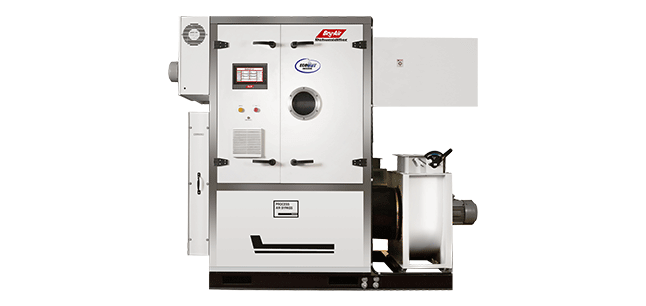
Bry-Air’s FLi Series uses an EcoDry metal silicate desiccant rotor and is designed for continuous industrial moisture removal. Its configuration can include additional air-treatment components to suit specific process and environmental requirements.
Regeneration and Moisture Discharge
Regeneration is necessary to restore the desiccant’s moisture-removal capacity. Heated regeneration air passes through the appropriate rotor section, carrying the removed moisture away from the system for discharge.
The heat source, airflow, and operating parameters influence overall performance. Bry-Air’s FLi Series supports multiple regeneration heat-source options, including electrical heating, steam, thermic fluid, and direct or indirect fired gas, subject to the selected configuration.
System selection should consider available utilities, energy costs, operating schedules, and the required humidity level. Proper engineering helps balance moisture-removal performance with energy consumption and maintenance requirements.
What Features Should Businesses Look for in a Warehouse Dehumidifier?
Choosing an industrial dehumidifier requires more than comparing equipment capacity. The system must match the actual moisture load and the environmental conditions in which it will operate.
Airflow Capacity and Moisture Removal Requirements
Airflow capacity describes the volume of air a system can process over a specified period. However, airflow alone does not establish how much moisture a dehumidifier can remove. Performance also depends on inlet temperature, inlet humidity, required outlet conditions, and the characteristics of the application.
Warehouse operators should evaluate the space dimensions, air leakage, ventilation rates, moisture entering with products, and frequency of loading activities. These factors help determine the required equipment capacity.
Bry-Air’s FLi Series product page lists process airflow capacities from 2,500 to 25,000 cubic metres per hour. The appropriate model should be selected through application-specific engineering rather than relying on warehouse size alone.
Filtration and Integrated Air Treatment
Industrial warehouses may require filtration alongside humidity control. Pre-filters can remove particles from incoming air, while additional filtration stages may support specific cleanliness requirements.
Depending on the application, pre-cooling and post-cooling can also help manage process air temperature. Bypass arrangements provide additional flexibility for controlling airflow and adapting the system to particular air-handling needs.
These options are useful when moisture removal must be coordinated with other environmental parameters. The required configuration should be determined according to product sensitivity, operating conditions, and the intended air distribution strategy.
Controls and Environmental Monitoring
Humidity sensors and control systems help operators assess whether the warehouse is maintaining its specified conditions. Monitoring can also identify changes associated with door openings, seasonal weather, equipment performance, or variations in the incoming moisture load.
Bry-Air offers optional control features for the FLi Series, including a microprocessor-based BrySmart controller, remote connectivity, and communication options such as BACnet and Modbus, depending on the configuration.
Data logging and trend analysis can help maintenance teams identify recurring environmental fluctuations and investigate potential operating issues. Monitoring should be supported by appropriate sensor placement, calibration, and periodic system checks.
How Can a Dehumidifier Warehouse Strategy Protect Inventory?
A warehouse humidity-control strategy should address the entire storage environment rather than focusing exclusively on equipment installation. The system needs to work alongside building design, operational procedures, and inventory requirements.
Assessing Storage Zones and Product Requirements
Different products may have different temperature and humidity tolerances. A facility storing general goods may not need the same environmental conditions as a space holding sensitive electronics or moisture-reactive materials.
Businesses should identify which areas require controlled humidity and determine the acceptable operating range for each zone. Separating areas with different environmental requirements can help prevent unnecessary conditioning and improve control.
A properly designed dehumidifier warehouse solution should consider room layout, air distribution, equipment placement, and the movement of people and goods. Airflow must reach the intended storage areas without creating poorly controlled zones.
Managing Air Leakage and Moisture Entry
Even a suitably sized dehumidifier may struggle when uncontrolled moisture continuously enters the warehouse. Gaps around doors, poorly sealed building elements, wet incoming products, and excessive outdoor air intake can increase the system’s workload.
Reducing unnecessary air leakage and addressing water infiltration can improve environmental stability. Warehouse teams should also establish procedures for handling damp packaging, responding to spills, and managing goods arriving from different temperature conditions.
These measures support the dehumidification system and can help reduce unnecessary energy use.
Maintenance and Performance Verification
Regular maintenance helps preserve the performance of industrial humidity-control equipment. Inspection schedules should reflect manufacturer recommendations, operating hours, environmental conditions, and the specific system configuration.
Filters may require cleaning or replacement, sensors should be checked, and airflow conditions should be reviewed. The desiccant rotor, seals, fans, and regeneration components should be maintained according to the manufacturer’s instructions.
Performance verification should include reviewing humidity trends and confirming that the system achieves the required operating conditions under representative warehouse loads. Any persistent deviation should be investigated rather than addressed solely by changing control settings.
Conclusion
Industrial warehouse humidity control helps protect inventory, reduce moisture-related deterioration, and maintain suitable environmental conditions for sensitive products. Selecting an effective dehumidification system requires careful evaluation of airflow, moisture load, temperature, storage requirements, energy use, and maintenance needs.
Desiccant technology can provide reliable moisture removal for applications that require controlled humidity, while integrated filtration, cooling, and monitoring options can support broader environmental management objectives. However, equipment selection should always be based on application-specific engineering and verified performance requirements.
Bry-Air provides industrial dehumidification solutions, including its FLi Series, for demanding moisture-control applications. If your facility needs a suitable humidity-control solution, Contact Us to discuss your warehouse requirements and explore an industrial dehumidification system designed for your operating conditions.
