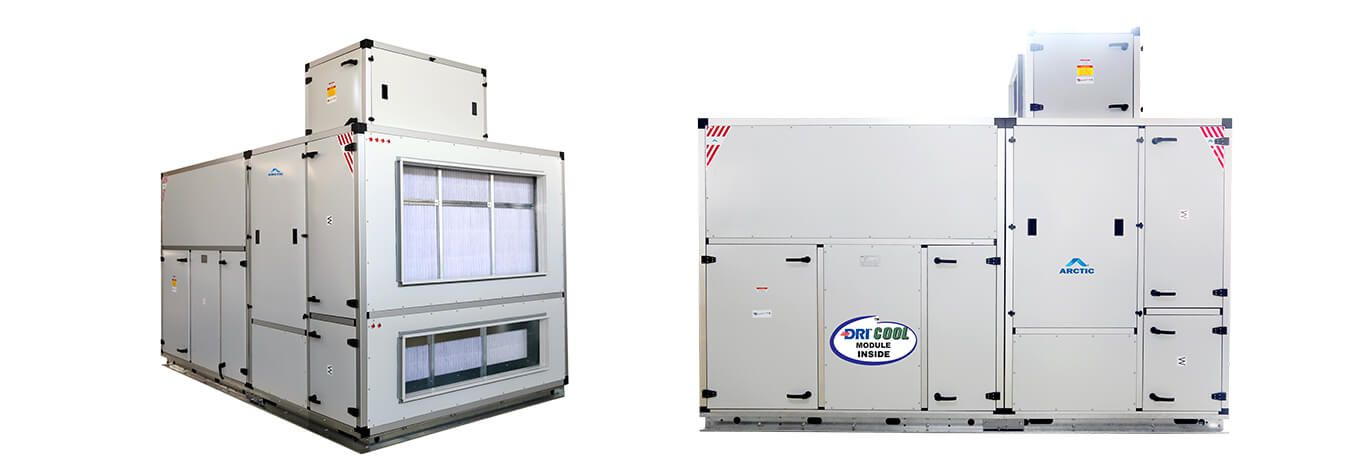
Cooling a warehouse requires a different approach from cooling a conventional office or smaller enclosed space. Large floor areas, high ceilings, frequent air exchange, heat-generating equipment, and large doors can all affect indoor temperatures. Traditional mechanical cooling can become energy-intensive when a system needs to condition a substantial volume of air for long operating periods.
Evaporative cooling offers another way to manage these conditions by using the cooling effect created when water evaporates into an air stream. Depending on the system design, evaporative cooling can be used directly, indirectly, or through multiple stages that combine different cooling methods. Understanding these options helps warehouse operators, facility managers, and HVAC consultants assess which warehouse cooling solutions may suit a particular facility.
Why Warehouse Cooling Requires Careful Planning
A warehouse can have a large internal volume without having the same cooling requirements throughout the space. Heat may accumulate near ceilings, equipment can add sensible heat, and loading areas can introduce outdoor air whenever doors are opened. Occupancy patterns and ventilation requirements can also change throughout the operating day.
The building envelope has a significant influence on indoor conditions. Roof construction, insulation, solar exposure, air leakage, and the orientation of the building can all affect the amount of heat entering the space. A cooling system therefore needs to account for both the characteristics of the building and the conditions of the incoming outdoor air.
Warehouse cooling design should consider several factors:
- Building size and ceiling height
- Outdoor temperature and humidity
- Internal heat generation
- Ventilation and fresh-air requirements
- Air movement and distribution
- Operating schedules
- Desired indoor temperature and humidity
These factors help determine whether evaporative cooling, mechanical refrigeration, ventilation, or a combination of technologies is appropriate.
What Is Evaporative Cooling?
Evaporative cooling reduces air temperature by using the heat required to evaporate water. As water changes from liquid to vapour, it absorbs heat from the surrounding air. The resulting air stream can therefore have a lower dry-bulb temperature.
The effectiveness of evaporative cooling depends strongly on the moisture content of the incoming air. Dry outdoor air has greater capacity to absorb additional moisture, making evaporative cooling particularly useful in suitable climatic conditions. In humid environments, the amount of cooling available through direct evaporation can be more limited.
Evaporative systems can be designed in different configurations. Direct systems allow water to evaporate directly into the supply air, while indirect systems transfer cooling through a heat exchanger without adding moisture to the primary supply-air stream. Multi-stage systems can combine these principles to provide greater control over temperature and humidity.
How Does Evaporative Cooling Work in a Warehouse?
The basic process begins with outdoor air entering the cooling system. Depending on the equipment configuration, the air may first pass through an indirect cooling stage, followed by a direct evaporative stage. The cooled air is then supplied into the warehouse through an appropriate air-distribution system.
Indirect cooling can lower the temperature of the supply air without increasing its moisture content. A direct stage can then provide additional cooling through evaporation where the air conditions allow it. This combination can provide a broader operating range than relying on a single evaporative process.
The effectiveness of the system depends on airflow, outdoor conditions, water availability, heat-load characteristics, and the design of the air-distribution system. Correct sizing is therefore essential. A system that supplies cooled air without sufficient distribution planning may not provide consistent conditions throughout a large warehouse.
Direct vs. Indirect Evaporative Cooling
Direct evaporative cooling brings the supply air into contact with water or a wetted medium. Water evaporates into the air and lowers its dry-bulb temperature, but the moisture content of the air increases at the same time.
Indirect evaporative cooling uses a heat exchanger to transfer cooling from one air stream to another. The primary supply air can be cooled without direct contact with the evaporative water stream, allowing its moisture content to remain relatively unchanged.
The main distinction can be summarised as follows:
- Direct cooling: Greater evaporative cooling effect, with increased supply-air moisture.
- Indirect cooling: Cooling without directly adding moisture to the primary supply air.
- Multi-stage cooling: Combines different cooling processes to achieve additional temperature reduction and greater control.
The appropriate configuration depends on outdoor humidity, required indoor conditions, ventilation requirements, and the acceptable moisture level within the warehouse.
How Multi-Stage Evaporative Cooling Can Improve Warehouse Cooling
Multi-stage evaporative cooling can combine indirect and direct cooling processes in a sequence. The first stage can reduce the temperature of incoming air without adding moisture to the primary air stream. A subsequent direct stage can provide additional cooling when the remaining air conditions are suitable for evaporation.
This arrangement can make better use of the available evaporative cooling potential. It also provides a way to consider sensible cooling and moisture control separately rather than relying entirely on one cooling mechanism.
For large warehouses, multi-stage systems can be considered where the objective is to provide substantial airflow with lower reliance on conventional refrigeration. The actual energy performance will depend on climate, system design, operating hours, fan power, water consumption, and control settings.
Warehouse Ventilation and Cooling Work Together
Cooling and ventilation cannot always be treated as separate concerns. Warehouses often require outdoor air for ventilation, pressure control, pollutant dilution, or operational reasons. Bringing outdoor air into a building also introduces its temperature and humidity characteristics.
An evaporative cooling system can combine outdoor-air movement with temperature reduction, but the design must account for the resulting indoor moisture conditions. Airflow patterns are also important because a large warehouse may require air to travel significant distances before reaching occupied or operational areas.
Good air distribution should minimise stagnant zones and provide suitable air movement across the occupied space. Fan selection, duct arrangement, discharge location, and airflow volume all influence the effectiveness of warehouse ventilation and cooling.
Managing Air Quality Alongside Cooling
Temperature is only one part of warehouse environmental control. Depending on the materials stored and activities taking place inside the facility, airborne particles, gases, odours, or other contaminants may also need to be controlled.
Where filtration and contaminant removal are required alongside cooling, industrial air purification systems can form part of the wider air-treatment strategy. Air purification requirements should be assessed according to the type and concentration of contaminants, required filtration efficiency, airflow rate, and operating conditions.
Cooling equipment should not be expected to perform every air-treatment function. Separating temperature control from filtration and purification can allow each part of the HVAC system to be designed according to its specific purpose.
When Is Granular Media Filtration Relevant?
Some warehouse environments may require additional treatment for gases, vapours, or chemical contaminants rather than relying only on particulate filtration. Granular media can be selected to adsorb specific gaseous contaminants from an air stream.
The suitability of granular media filtration depends on the contaminant type, concentration, airflow, media characteristics, and required removal performance. Media selection should therefore be based on the actual air-treatment requirement rather than using a general filtration specification.
This type of filtration can complement a cooling and ventilation system where air-quality control is part of the facility’s environmental requirements. It should be considered as one component within the overall air-treatment design.
What Are the Benefits of Evaporative Cooling for Warehouses?
Evaporative cooling can provide several advantages where the outdoor climate and warehouse requirements are suitable. Its effectiveness comes from using the latent heat of water evaporation rather than relying entirely on mechanical refrigeration.
Potential advantages include:
- Lower dependence on refrigeration-based cooling
- High airflow capacity for large spaces
- Effective cooling under suitable outdoor conditions
- Integration with outdoor-air ventilation
- Potentially lower energy consumption in appropriate applications
- Suitable operation for large-volume spaces
These advantages should be assessed alongside water consumption, humidity requirements, maintenance, filtration, fan energy, and local climate. Evaporative cooling is not automatically the best choice for every warehouse.
What Should Be Considered Before Choosing a Warehouse Cooling System?
The first consideration should be the required indoor condition. A facility that only needs to reduce excessive heat may have different requirements from one that needs precise temperature and humidity control.
Outdoor climate is equally significant. Temperature and relative humidity determine how much cooling can be achieved through evaporation. A detailed assessment of seasonal conditions helps establish whether direct, indirect, or multi-stage evaporative cooling is appropriate.
The following factors should also be evaluated:
- Required airflow and air changes
- Internal sensible heat load
- Outdoor temperature and humidity
- Water availability and quality
- Required indoor humidity
- Filtration and air-quality requirements
- Maintenance access
- Control requirements
- Available installation space
System selection should consider the complete operating profile rather than relying on nominal cooling capacity alone.
Can Evaporative Cooling Replace Conventional Air Conditioning?
Evaporative cooling can reduce the need for conventional refrigeration in suitable applications, but it does not replace mechanical air conditioning in every situation. The choice depends heavily on climate, humidity, required indoor conditions, and the facility’s cooling load.
Direct evaporative cooling is generally more dependent on low outdoor humidity because it adds moisture to the supply air. Indirect and multi-stage systems can provide additional options where moisture addition needs to be limited.
A hybrid system may also be appropriate where different technologies are used under different operating conditions. The objective should be to match the cooling method to the building’s actual requirements rather than selecting equipment based solely on the technology category.
Maintaining Performance Over Time
The performance of a warehouse cooling system depends on more than its original design. Filters, cooling media, water circuits, fans, heat exchangers, controls, and other components require appropriate inspection and maintenance.
Water quality can be particularly relevant to evaporative systems. Mineral deposits, biological growth, and blocked media can affect airflow, heat transfer, and system hygiene if maintenance is inadequate. Preventive maintenance should therefore follow the equipment manufacturer’s requirements and the operating environment.
Controls should also be reviewed periodically. Sensors, airflow settings, temperature controls, and operating schedules influence how the system responds to changing outdoor and indoor conditions. Proper maintenance helps preserve the intended performance of the cooling system.
Conclusion
Warehouse cooling requires a system that accounts for building volume, outdoor conditions, internal heat loads, ventilation, humidity, and air distribution. Evaporative cooling can provide an efficient method of reducing air temperature in suitable climates, while indirect and multi-stage configurations offer additional control over moisture and cooling performance.
The right approach should be based on the complete operating requirements of the facility. Evaluating climate data, airflow, water conditions, indoor targets, filtration needs, and maintenance requirements can help determine whether evaporative cooling is appropriate and which configuration best fits the application.
For technical requirements or guidance on suitable air-treatment and cooling configurations, contact Desiccant Rotors International to discuss the requirements of your warehouse cooling project.
Frequently Asked Questions About Warehouse Cooling Solutions
What are the best warehouse cooling solutions?
The appropriate warehouse cooling solution depends on building size, outdoor climate, humidity, internal heat loads, ventilation requirements, and desired indoor conditions. Evaporative, mechanical, hybrid, and ventilation-based systems can all have suitable applications.
How does evaporative cooling work in a warehouse?
Evaporative cooling uses water evaporation to remove heat from an air stream. Direct systems add moisture to the supply air, while indirect systems transfer cooling through a heat exchanger without directly adding moisture to the primary air stream.
Is evaporative cooling suitable for large warehouses?
Evaporative cooling can be suitable for large warehouses where the outdoor climate provides sufficient evaporative potential and the required indoor humidity conditions allow its use. Airflow and distribution also need to be properly designed.
Does evaporative cooling use less energy than air conditioning?
Evaporative cooling can use less energy than conventional refrigeration-based cooling in suitable conditions because it relies on water evaporation and air movement rather than the same refrigeration cycle. Actual energy consumption depends on system design, climate, airflow, controls, and operating hours.
Does warehouse cooling also require air purification?
Some warehouses may require air purification in addition to temperature control, particularly where dust, gases, odours, or other contaminants are present. The required filtration or purification method depends on the specific contaminants and indoor air-quality requirements.
